
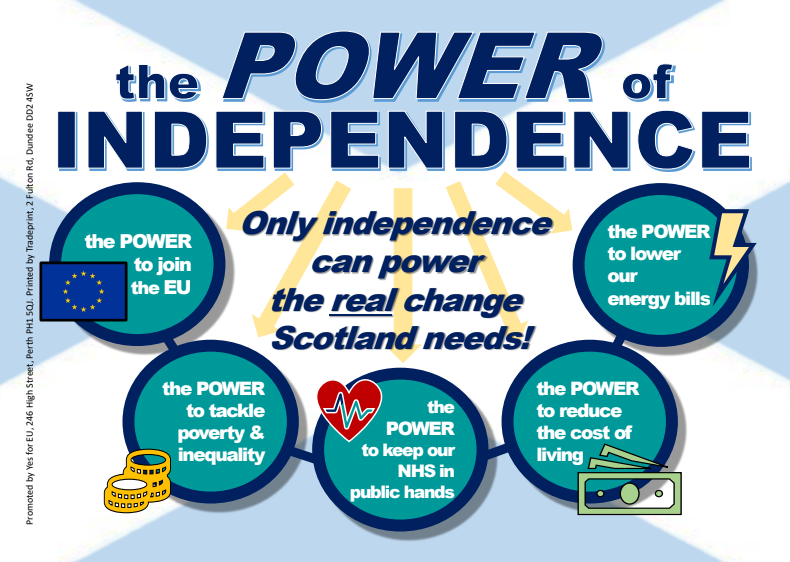
The Power of Independence – what is it, and why do we need it?
The Scottish Parliament at Holyrood has very limited power to control many key things that affect our lives: our energy bills, the cost of living, the NHS, poverty, Brexit, and more. These come under the ultimate control of the UK government. The Scottish Government mitigates some of the worst UK policies – for example tackling poverty with the Scottish Child Payment, and the Winter Heating Payment for pensioners after the UK payment was stopped – but overall, Scots suffer because of poor decisions made by the UK government in London. Such UK policies impoverish our lives and harm our children’s future.
The prime example of bad UK decisions is Brexit, which continues to seriously damage Scotland’s economy and people’s lives. If Scotland remains tied to the UK, we continue to be at the mercy of bad UK policies. We need independence as it will give Scotland full powers to govern in the interests of the people of Scotland.
In the Holyrood elections on 7th May 2026, we can bring the Power of Independence closer by voting for a party(ies) that are pro-independence and pro-EU.
What powers will independence give us?
The Power to rejoin the EU
Independence will give Scotland the power to rejoin the European Union. In 2016 Scots voted democratically to remain in the EU but we were forced to leave. Brexit was a disastrous UK decision which has created trade barriers and other difficulties between the UK and EU; this is causing the Scottish economy to shrink by £3bn per year – which impacts us all in our everyday lives. UK in a Changing Europe estimated that by 2025, UK GDP per capita was 6–8% lower than it would have been without Brexit. Investment was 12–18% lower, employment 3–4% lower, and productivity 3–4% lower. Scottish exporters have suffered, many businesses have closed. The decision to leave the EU has imposed a large and persistent cost on Scotland’s economy. And that’s not all: the loss of free movement has deprived Scots of study, work, and cultural opportunities, and created staff shortages in crucial sectors including health and social care, agriculture and hospitality.
Joining the EU will enable independent Scotland to trade, grow our economy, and build relationships with our neighbours without the Brexit barriers, and so enhance the Scottish Government’s powers to improve our daily lives, including reducing the cost of living, lowering energy bills, keeping the NHS in public hands and bringing free movement to increase our opportunities – especially for young people – to freely live, study, work, and love across the continent of Europe.
To gain the power to join the EU, we need pro-independence / pro-EU elected representatives at Holyrood and Westminster. Scotland’s independence and EU membership are opposed by all London-based political parties (see the chart below) – only the SNP and the Scottish Greens support an Independent Scotland joining the EU. Only independence will give us the power to fully rejoin the EU in our own right, to build strong relationships with our neighbours, and be democratically represented in Europe – claiming Scotland’s seat at the decision-making table in a global power bloc. To gain the power to join the EU, Scots must support pro-indy / pro-EU parties at the Holyrood elections in May 2026.
The Power to lower Energy bills
Scots’ energy bills are sky-high due to UK government energy policy which imposes high costs for consumers whilst allowing the big energy companies and their shareholders to pocket huge profits. UK policy also means that many Scots’ bills are very unfair as they are forced to pay higher standing charges than many down south, in spite of the fact that vast amounts of renewable energy are being produced on our doorstep. Brexit also contributes to our higher energy bills: leaving the EU’s Internal Electricity Market has added up to £370m a year to the price of power supplies from Europe, and this could amount to £10bn by the end of the decade. With independence we will have full control of our energy policy, and will join the EU’s energy market, making energy bills fairer and affordable. To gain the power to lower energy bills, Scots must support pro-indy / pro-EU parties at the Holyrood elections in May 2026.
The Power to reduce the cost of living and tackle poverty
For Scots the increase in the cost of living is the number one concern. Reasons for the increase, which affects many countries, include the impact of covid and Russia’s war on Ukraine. But in the UK including Scotland the cost-of-living crisis is worse because of Brexit: according to the LSE, the added costs of leaving the EU account for up to a quarter of the rise in food bills since the end of 2019, largely due to higher costs for traders. Many Scots have been driven into poverty as a result, and other UK policies make the situation even worse such as cutting benefits for children, families, and vulnerable people.
With independence, Scotland will have the power to tax people more fairly, so that the poorest pay less and the wealthy pay more. Control over the system of welfare benefits will ensure that the most vulnerable are supported and treated with dignity.
With EU membership, independent Scotland will have access to the single market and customs union, so it will be in our power to lower prices across the board. New trade routes that use ferries to Ireland / N.Ireland and the continent will reduce transport costs by removing the need to travel south to English ports. That will benefit Scottish exporters, holiday makers, musicians and tourists from abroad. To gain the power to reduce the cost of living and tackle poverty, Scots must support pro-indy / pro-EU parties at the Holyrood elections in May 2026.
The Power to keep the NHS in public hands
Although NHS Scotland is largely separate from the NHS in the rest of the UK, Scotland’s NHS remains under threat from UK London-based parties which, as in England, may promote privatisation in the Scottish Parliament too. The main threat comes from Reform UK – which may gain some MSPs in May – as they could replace the publicly-funded NHS with a system of private health insurance if they form a UK government after the next general election (2029 or sooner). Even as things stand, the amount of NHS funding in England affects funding for NHS Scotland. The NHS has also been severely impacted by Brexit, primarily through worsening workforce shortages. This has led to decreased quality of care and a reliance on non-UK/ non-EU recruitment, together with reduced supplies of medicines and medical isotopes.
Independence will protect us from UK policies of increasing privatisation and prevent the sharing of our medical data with the US spy-tech firm Palantir. Our EU membership would enhance this power through being included in the European Health Union and gaining investment in public services.
To gain the power to protect the NHS and keep it in public hands, Scots must support pro-indy / pro-EU parties at the Holyrood elections in May 2026.
In the Scottish Parliament elections on 7th May 2026, only two parties are committed to both Independence & EU membership for Scotland – the Scottish National Party (SNP) and the Scottish Greens.
This chart shows the policies of each of the main parties, and we strongly recommend voting for a Scottish party/parties committed to both Independence and EU membership for Scotland!
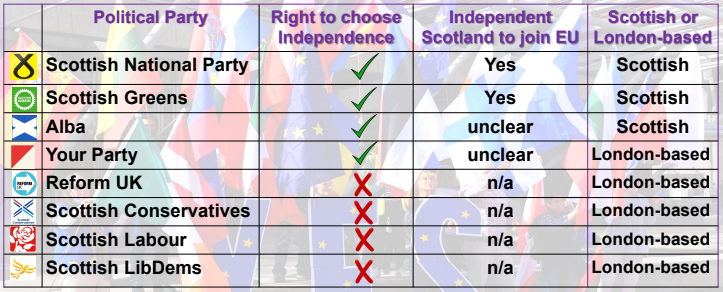
Why vote for a Scottish party, rather than a London-based party, at Holyrood 2026?
The London-based UK parties naturally prioritise ‘what’s best for the UK’. Scottish MPs from London-based parties – including Labour, Conservative, LibDem, possibly Reform UK – have to comply with their party’s UK policies regardless of whether they are in Scotland’s interests or not.
Only the Scottish parties that are pro-independence and pro-EU will help us gain the Power of Independence, and the Power of EU Membership. Those powers will enable us to govern Scotland in the interests of the Scottish people. They are the powers we need to create a better future for Scots. To gain the Power of Independence and EU membership, at the Holyrood elections on 7th May 2026, vote for a Scottish party / parties that are pro-indy and pro-EU!
Key sources (not an exhaustive list)
Joseph Rowntree Foundation (2025, October 06) ‘Poverty in Scotland 2025’. https://www.jrf.org.uk/poverty-in-scotland-2025
London School of Economics (2023, May) ‘Brexit and consumer food prices: 2023 update’, Brexit Paper 18. https://cep.lse.ac.uk/pubs/download/brexit18.pdf
Morrison, H. (2025, November 10)‘Scots face some of the steepest energy bill hikes in the UK’ The National. https://www.thenational.scot/news/25610677.scots-face-steepest-energy-bill-hikes-uk/
O’Carroll, L.(2024, October 25), ‘Brexit has put £370m a year on price of power from EU since 2021, experts say’. The Guardian. https://www.theguardian.com/business/2024/oct/25/brexit-has-put-370m-a-year-on-price-of-power-from-eu-since-2021-experts-say
Page, S. (2024, October 22). ‘Is independence in the EU now an economic necessity for Scotland?’ Bylines Scotland. https://bylines.scot/news/economics/is-independence-in-the-eu-now-an-economic-necessity-for-scotland/
Scottish Government, (2023, November), ‘An Independent Scotland in the EU’. https://www.gov.scot/publications/building-new-scotland-independent-scotland-eu/
UKICE (2025, December 04) ‘Brexit’s impact on the UK economy’. https://ukandeu.ac.uk/brexits-impact-on-the-uk-economy/
UKICE (2023, February 10) ‘What has Brexit meant for the NHS?’ https://ukandeu.ac.uk/what-has-brexit-meant-for-the-nhs/